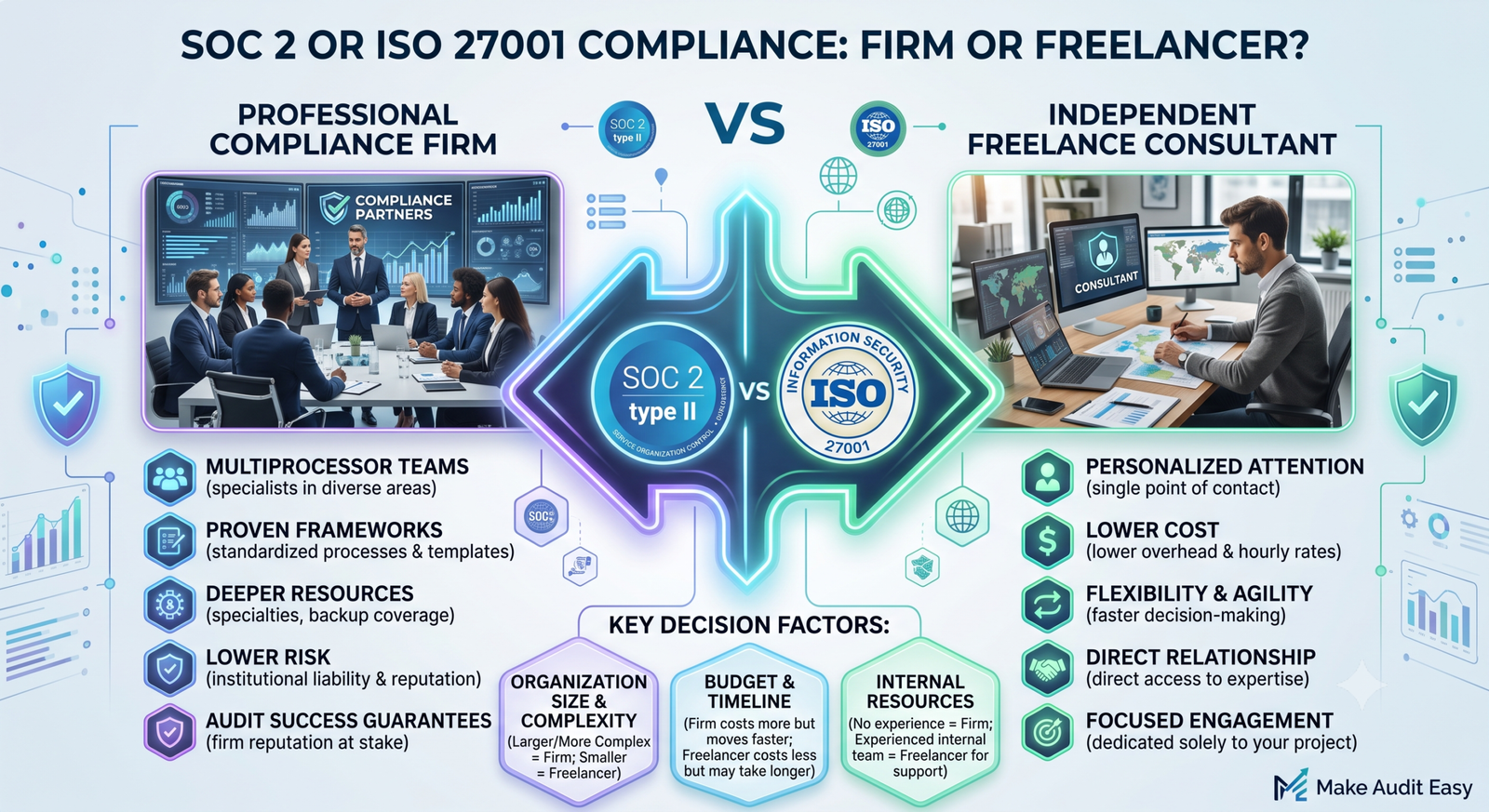
When a startup begins its SOC 2 or ISO 27001 journey, one of the first questions is often:
“Why should we hire a consulting firm? Can’t we just work with an experienced freelancer?”
The answer is: sometimes, a freelancer can be enough.
But as your compliance program becomes more complex, your customers become more demanding, and your business expands into global markets, the question changes.
It is no longer simply:
“Who can help us complete the compliance work?”
It becomes:
“Who can take us from where we are today to where our business needs to be tomorrow?”
That distinction matters.
A Freelancer Can Provide Expertise. A Firm Can Provide an Ecosystem.
An experienced freelancer can bring excellent knowledge.
They may have years of experience with SOC 2, ISO 27001, cybersecurity, risk management or audit preparation.
For a small, well-defined engagement, that may be perfectly suitable.
But compliance is rarely just about one person’s knowledge.
A typical SOC 2 or ISO 27001 journey can involve:
- Security controls
- Risk management
- Policies and procedures
- Governance
- Asset management
- Access management
- Vulnerability management
- Incident management
- Business continuity
- Vendor management
- Evidence collection
- Employee awareness
- Internal audit
- Management review
- Audit coordination
- Customer requirements
- Regulatory requirements
And different areas may require different expertise.
A single individual may be very strong in several areas.
A capable firm can potentially bring multiple specialists, processes, tools and continuity into the engagement.
The Real Question Is Not “Freelancer or Firm?”
This is an important distinction.
A bad firm is not automatically better than a good freelancer.
And a good freelancer is not automatically better than a good firm.
The right question is:
Does the partner have the expertise, capacity, accountability and continuity required for your compliance journey?
That is what startups should evaluate.
1. Compliance Is a Journey, Not a One-Time Deliverable
One of the biggest misconceptions about SOC 2 and ISO 27001 is that compliance is simply a project.
You implement some policies.
You close some gaps.
You collect evidence.
You complete an audit.
Done.
In reality, compliance needs to become part of the organization’s ongoing operating model.
Your business changes.
Your employees change.
Your infrastructure changes.
Your vendors change.
Your customers change.
Your risks change.
Your regulatory environment can change.
Your compliance program has to evolve with them.
This is where continuity becomes important.
If your entire compliance knowledge sits with one external individual, the organization can become dependent on that person.
A firm with appropriate processes and documentation can provide greater organizational continuity.
2. Startups Don’t Need Just an Auditor
This is where the discussion becomes particularly important for startups.
A startup may not know whether it needs:
- SOC 2 Type I or Type II
- ISO 27001
- Both
- VAPT
- vCISO support
- AI security controls
- GDPR readiness
- Customer-specific security controls
- Additional regulatory requirements
A startup may also have a completely different reason for pursuing compliance.
Perhaps an enterprise customer is asking for SOC 2.
Perhaps the company wants to enter the U.S. market.
Perhaps procurement teams are demanding ISO 27001.
Perhaps investors want stronger governance.
Perhaps the company is preparing to scale.
The partner therefore needs to understand the business objective behind the compliance requirement.
That’s more than simply knowing the framework.
3. What Happens When You Need More Than One Skill?
Imagine that during your SOC 2 or ISO 27001 journey you discover:
- A vulnerability management problem
- Weak access controls
- Inadequate vendor risk management
- Gaps in incident response
- Missing business continuity documentation
- Cloud security issues
- Security awareness gaps
- Evidence problems
Now you need different types of expertise.
A capable compliance firm may be able to bring in the appropriate specialists without forcing the startup to find and manage multiple independent resources.
That can simplify the journey.
4. Continuity Matters
Consider a simple scenario.
You have been working with a freelancer for six months.
They understand your environment.
They know your policies.
They understand your risks.
They know your evidence.
Then they become unavailable.
What happens?
A strong professional firm should have processes for documentation, knowledge transfer and continuity so that the project does not depend entirely on one person.
For a startup preparing for an important customer deadline, that continuity can be valuable.
5. Accountability Becomes Important
Compliance projects often involve sensitive information.
You may share:
- Architecture information
- Security policies
- Risk registers
- Vulnerability information
- Customer requirements
- Internal processes
- Access-control information
- Vendor information
- Security evidence
The question should therefore not simply be:
“Does this person know SOC 2?”
You should also ask:
Who is accountable for the engagement?
How is confidential information handled?
How is work documented?
Who supports the project if the primary consultant becomes unavailable?
What happens after implementation?
Who helps during the audit?
These are important partner-selection questions regardless of whether you choose a freelancer or a firm.
6. Global Growth Changes the Requirement
For a startup serving only a small number of customers, compliance may initially be relatively straightforward.
But imagine that the same startup begins selling internationally.
Now customers may ask:
“Do you have SOC 2?”
“Do you have ISO 27001?”
“Where is your data hosted?”
“How do you manage vendors?”
“How do you handle incidents?”
“What are your business continuity arrangements?”
“How do you manage privacy?”
“How do you manage AI-related risks?”
The company is no longer simply trying to obtain a certificate.
It is building a globally trusted business.
That requires a partner who understands the broader journey.
7. A Firm Can Scale With the Startup
Startups change quickly.
A company that has 20 employees today may have 100 employees next year.
A company serving five customers may soon serve 50 enterprise customers.
Its technology stack may change.
Its geography may change.
Its regulatory obligations may change.
Its compliance requirements may expand.
The ideal partner should therefore have the ability to scale its support as the organization grows.
This is one area where a capable firm may have an advantage over an individual consultant.
8. But Don’t Choose a Firm Just Because It Is a Firm
This is equally important.
Big does not automatically mean better.
A large consulting organization may have significant resources but may also provide a standardized engagement that doesn’t fit your startup.
A small specialist firm may provide much more hands-on support.
An experienced freelancer may sometimes provide deeper personal attention.
Therefore, startups should evaluate the actual capability of the provider, not just the size of the organization.
Ask:
Experience
Have they worked with companies similar to yours?
Expertise
Do they understand both compliance and cybersecurity?
Business understanding
Do they understand why you need compliance?
Delivery capability
Can they actually help implement controls, or do they only provide advice?
Audit readiness
Can they help you prepare evidence and coordinate the readiness process?
Continuity
What happens if the primary consultant becomes unavailable?
Scalability
Can they support you as the company grows?
Global understanding
Do they understand the expectations of international enterprise customers?
Accountability
Is there a clear organization responsible for the engagement?
So, Is a Firm Better Than a Freelancer?
There is no universal answer.
For a simple, limited engagement, an experienced freelancer may be entirely appropriate.
For a startup undertaking a broader compliance transformation—with multiple frameworks, cybersecurity requirements, enterprise customers, international expansion and ongoing compliance—a capable specialist firm can provide advantages in breadth of expertise, continuity, scalability and organizational support.
The important word is capable.
Don’t choose a firm because it is bigger. Choose a partner because it can take responsibility for the journey you need to complete.
This Is Where Make Audit Easy Is Different
At Make Audit Easy (MAE), we believe startups don’t need another company that simply hands them a compliance checklist.
They need someone who understands:
Where they are today.
Where they want to go.
What their customers expect.
What compliance they actually need.
What needs to happen first.
What can wait.
How to implement it.
How to become audit-ready.
And ultimately:
How to make the journey easier.
That’s why we position MAE not simply as a compliance service provider, but as a startup-focused cybersecurity, compliance and audit partner.
Our objective is to help startups and growing companies navigate their journey from:
Startup → Audit-Ready → Customer-Ready → Globally Trusted
Because compliance should not become another obstacle to growth.
It should become part of the foundation that helps a startup earn trust, win enterprise customers and expand into global markets.
Make Audit Easy
Your Compliance Goal. Our Expertise. A Simpler Journey.
SOC 2 | ISO/IEC 27001 | Cybersecurity | AI Security | VAPT | vCISO | Risk & Compliance
Fuel Your Trust. Power Your Growth.