A practical cybersecurity and compliance roadmap for SaaS startups
Building a SaaS company is already challenging.
As a founder, your priorities are usually product development, customers, hiring, sales, fundraising, and growth. Cybersecurity and compliance may feel like something you can deal with later—especially when you are still a small team with limited resources.
But there is an important distinction:
You may not need a large cybersecurity or compliance team on Day One. You do need to build your business in a way that protects your customers, your data, and your brand from Day One.
As your SaaS company grows, your security requirements will also change.
Early on, your focus may be on basic security hygiene and protecting your business from avoidable risks. As you start serving larger customers, processing sensitive information, entering regulated markets, or going through enterprise procurement, cybersecurity and compliance can become an important part of winning and retaining customers.
This is where a structured cybersecurity and compliance partner can help.
The SaaS Growth Journey: Security Should Grow With Your Business
A startup does not necessarily need to spend heavily on cybersecurity before it has a product, customers, or meaningful data.
However, postponing security completely can create problems later.
A better approach is to think about cybersecurity as a growth journey.
| SaaS Growth Stage | Primary Business Focus | Security & Compliance Focus |
|---|---|---|
| Idea / MVP | Build product | Basic security foundations |
| Early customers | Product-market fit | Access control, backups, secure development, policies |
| Growing startup | More customers & data | Risk assessment, security controls, VAPT, formal policies |
| Enterprise sales | Larger customers | SOC 2, ISO 27001 and customer security requirements |
| High growth | Scale operations | Continuous security & compliance management |
| Regulated / mature business | Enterprise & regulated markets | Strong governance, audits, certifications and specialized security |
The key is not to ask:
“Do I need compliance?”
Instead ask:
“What level of security and assurance does my business need at its current stage—and what will my customers expect at the next stage?”
Stage 1: You Are Building Your SaaS MVP
At the beginning, you may have:
- A small founding team
- Limited customer data
- A cloud-hosted application
- A small technology stack
- Few employees
- Limited revenue
- No enterprise customers
At this stage, hiring a full-time CISO, building a large security department, or immediately pursuing multiple certifications may not make commercial sense for every startup.
But basic security cannot be ignored.
Start with the fundamentals.
Your startup should consider:
- Strong authentication
- Multi-factor authentication for critical accounts
- Role-based access control
- Secure password management
- Regular backups
- Endpoint protection
- Cloud security configuration
- Encryption where appropriate
- Secure software development practices
- Vulnerability management
- Logging and monitoring
- Employee security awareness
- Vendor assessment
- Incident response planning
- Data classification
- Appropriate privacy and security policies
These controls can significantly reduce avoidable risks.
The objective at this stage is simple:
Build securely without slowing down the startup.
Stage 2: Your First Customers Are Arriving
Now the situation changes.
You have real customers.
You are storing customer information.
Your application is becoming business-critical.
Your team is growing.
Your technology environment is becoming more complicated.
And customers may start asking questions such as:
How do you protect our data?
Where is our data stored?
Do you have an information security policy?
Do you perform vulnerability assessments?
Do you have an incident response process?
Who has access to production?
These questions are not necessarily asking for a certification immediately.
Customers want confidence.
This is the point where a startup should start formalizing its security program.
Stage 3: Your SaaS Company Starts Growing Quickly
Growth creates a different type of security challenge.
More customers mean more data.
More employees mean more access.
More integrations mean more third-party risk.
More infrastructure means more configurations to manage.
And more business activity means more opportunities for security incidents.
At this stage, startups should consider developing a structured cybersecurity and compliance program.
This can include:
Security Governance
- Information security policies
- Risk management
- Asset management
- Access management
- Security responsibilities
- Security awareness training
Technical Security
- Vulnerability Assessment and Penetration Testing (VAPT)
- Cloud security reviews
- Application security
- Secure configuration
- Logging and monitoring
- Backup and recovery
- Incident response
Compliance Readiness
Depending on the company’s market and customers, this may include preparation for:
- SOC 2
- ISO/IEC 27001
- PCI DSS
- HIPAA
- GDPR
- Applicable data-protection requirements
- Industry-specific requirements
The important point is:
Do not pursue a framework simply because everyone else is doing it.
Choose security and compliance requirements based on your customers, market, data, regulations, contracts and growth strategy.
Stage 4: You Start Selling to Enterprise Customers
This is often where cybersecurity moves from being primarily an internal risk-management issue to becoming a business-development requirement.
Imagine you are a SaaS founder trying to close a $100,000 enterprise customer.
Your sales team has completed the product demonstration.
The commercial discussion is progressing.
Then the customer’s procurement or security team asks:
“Do you have SOC 2?”
Or:
“Do you have ISO 27001?”
Or:
“Can you provide your latest penetration-testing report?”
Or:
“Can you complete our vendor security questionnaire?”
Now cybersecurity can directly affect the sales process.
The customer may not necessarily require every certification. Requirements vary by organization and industry.
But enterprise buyers commonly perform security and risk assessments before onboarding technology vendors.
That means security can become part of your customer trust infrastructure.
Cybersecurity Is Not Just an IT Expense
For a SaaS company, cybersecurity can support several areas of the business.
1. Protect Your Brand
A security incident can create financial and operational consequences, but it can also affect customer confidence.
Your brand is built on trust.
If customers give your company their data, they expect you to protect it appropriately.
2. Support Enterprise Sales
Large customers often have security and compliance requirements.
Having an organized security program can make it easier for your sales team to respond to customer security questions.
3. Reduce Business Risk
Security controls help reduce the likelihood and potential impact of incidents such as:
- Unauthorized access
- Data exposure
- Account compromise
- Malware
- Phishing
- Vulnerabilities
- Misconfiguration
- Insider misuse
No security program can eliminate every risk.
The goal is to identify, manage and reduce risk systematically.
4. Build Customer Confidence
A mature security program can provide evidence that security is being managed rather than treated as an afterthought.
Depending on your business requirements, this evidence may include:
- Policies
- Risk assessments
- Security testing
- Audit reports
- SOC 2 reports
- ISO 27001 certification
- Security questionnaires
- Incident-response procedures
- Business continuity documentation
When Should a SaaS Startup Bring in a Cybersecurity or Compliance Partner?
There is no universal revenue number or employee count that determines when a startup must engage a cybersecurity or compliance service provider.
Instead, look for business triggers.
Consider getting external cybersecurity or compliance support when:
Your customers start asking security questions
If security questionnaires are appearing regularly in your sales pipeline, your security program needs to keep pace.
You are targeting enterprise customers
Enterprise sales can introduce security assessments, vendor-risk reviews and contractual security requirements.
You handle sensitive customer information
The sensitivity and volume of data you process should influence your security approach.
Your technology environment is becoming complex
More cloud services, APIs, integrations, employees and vendors increase the number of things that need to be managed.
You are preparing for SOC 2 or ISO 27001
Formal frameworks require structured preparation, documentation, controls, evidence and ongoing management.
You are entering regulated markets
Industry and geographic requirements may introduce additional obligations.
Your sales team is losing deals because of security requirements
This is a particularly important signal.
Cybersecurity has now become a growth requirement, not simply an IT requirement.
Should You Hire an Employee or Use a Cybersecurity Firm?
A common question for founders is:
“Should I hire a cybersecurity person or work with an external company?”
The answer depends on the company’s stage, complexity and requirements.
For an early-stage SaaS company, building a complete internal security and compliance team may not be practical.
An external specialist can provide access to multiple capabilities without requiring the startup to immediately build a large internal team.
For example, a startup may need:
- Security consulting
- VAPT
- SOC 2 implementation
- ISO 27001 implementation
- Internal audit
- Compliance advisory
- vCISO support
- Security policies
- Risk management
- Security awareness
- Audit preparation
Instead of hiring several specialists, a startup can use an external cybersecurity and compliance partner and gradually build internal capability as the company grows.
Freelancer vs. Cybersecurity & Compliance Firm
Freelancers can be useful for specific technical assignments.
For example:
- A penetration test
- A security configuration review
- A policy document
- A one-time technical assessment
But compliance and cybersecurity programs can become much broader than a single assignment.
A growing SaaS company may need multiple capabilities working together:
Strategy → Risk → Policies → Controls → Implementation → Evidence → Testing → Internal Audit → External Audit → Continuous Improvement
This is where an experienced cybersecurity and compliance firm can provide a broader engagement model.
The objective should not simply be:
“Get us a certificate.”
The objective should be:
“Help us build a security program that supports our business and can withstand customer and audit scrutiny.”
Don’t Wait Until Your Biggest Customer Asks
One of the most expensive times to start preparing for compliance is immediately after an enterprise customer makes it a contractual or procurement requirement.
Why?
Because your sales opportunity may already be active.
Your customer wants answers.
Your team may not have the documentation.
Your controls may not be implemented.
Evidence may not exist.
And suddenly the startup is trying to build months of security processes while simultaneously trying to close a major customer.
A better approach is to anticipate the next stage of growth.
For example:
Startup → Basic Security
↓
Growing SaaS → Formal Security Program
↓
Enterprise Sales → SOC 2 / ISO 27001 Readiness
↓
Mature SaaS → Continuous Compliance & Security Management
This allows security to grow with the business instead of becoming a roadblock to growth.
The Make Audit Easy Approach
At Make Audit Easy (MAE), we believe startups should not have to choose between moving fast and building trust.
A startup does not necessarily need a huge cybersecurity department from Day One.
What it needs is the right level of expertise at the right stage.
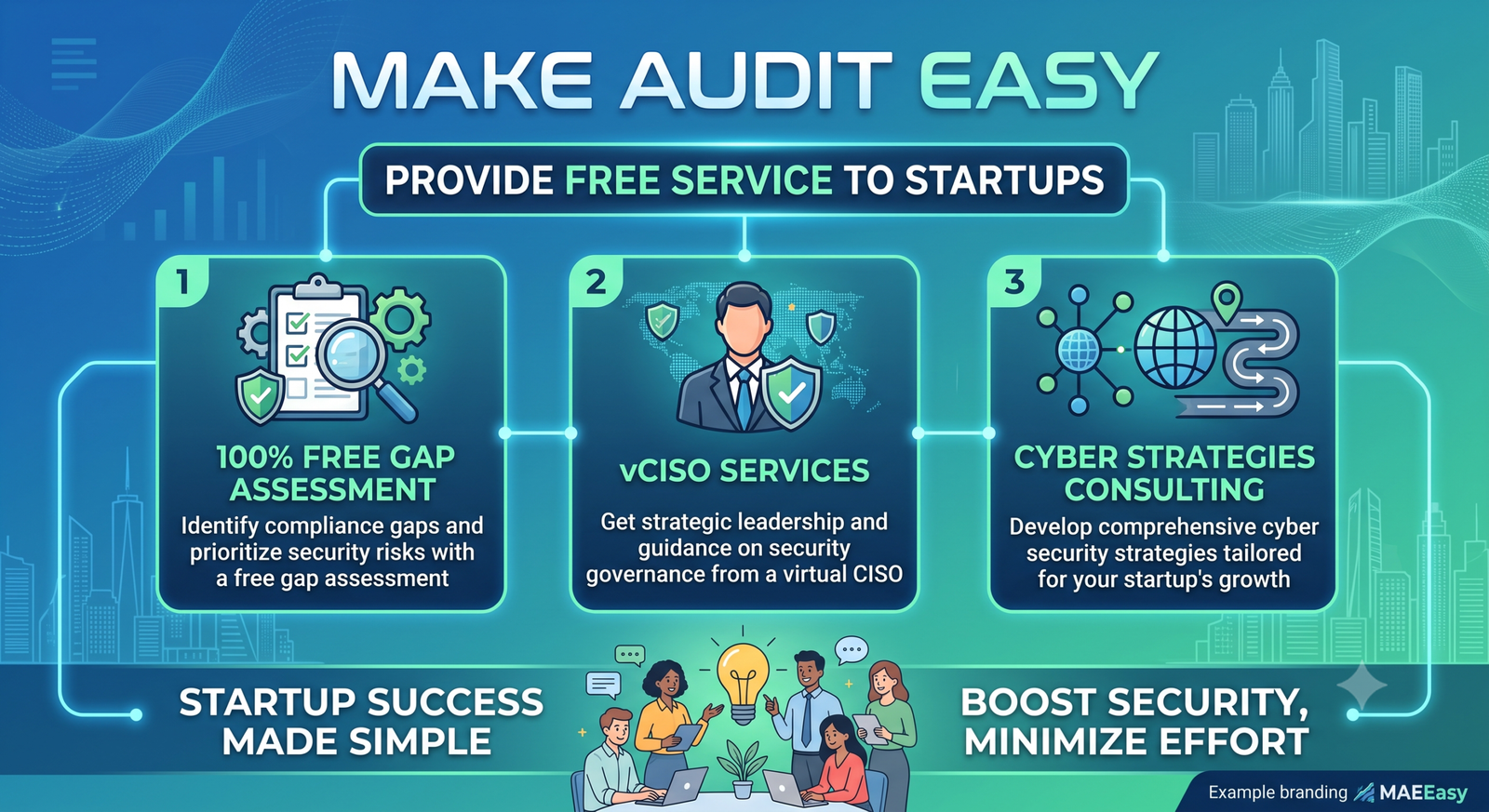
Make Audit Easy helps startups, fast-growing companies, SMEs and enterprises with cybersecurity, compliance and audit requirements.
Our services include:
- SOC 2 Type I & Type II
- ISO/IEC 27001
- Vulnerability Assessment & Penetration Testing (VAPT)
- AI Security & ISO/IEC 42001
- PCI DSS
- GDPR
- HIPAA
- DPDP
- vCISO Services
- Cybersecurity Audits
- Internal Audits
- Compliance Readiness & Implementation
Our focus is not simply on documentation or certification.
We help organizations understand where they are today, what their customers require, what risks they need to address, and what they need to do next.
A Practical SaaS Security Roadmap
If you are building a SaaS company today, consider this roadmap:
0–10 Customers
Focus on:
Security Foundations
Protect accounts, infrastructure, source code, endpoints and customer data.
10–50 Customers
Focus on:
Formalization
Create policies, identify risks, establish controls and start collecting evidence.
50+ Customers / Rapid Growth
Focus on:
Security Program
Introduce structured risk management, security testing, monitoring and compliance readiness.
Enterprise Sales
Focus on:
Customer Assurance
Evaluate whether SOC 2, ISO 27001 or other customer-specific requirements are appropriate.
Mature SaaS Business
Focus on:
Continuous Security & Compliance
Security should become an ongoing business process rather than a one-time certification project.
Final Thought for SaaS Founders
You don’t have to become a cybersecurity expert to build a secure SaaS company.
You don’t necessarily need a large compliance department when you are still validating your product.
But you should not treat cybersecurity as something that only matters after you become successful.
Protect your product early.
Protect your customer data.
Build sensible security foundations.
Formalize your security program as you grow.
And when enterprise customers, sensitive data, regulations or rapid growth increase the requirement for assurance, bring in the right cybersecurity and compliance expertise.
Because the goal of cybersecurity is not to slow your startup down.
The goal is to help your startup grow with confidence.
Make Audit Easy
Cybersecurity. Compliance. Audit Readiness.
Helping startups and growing companies become secure, audit-ready and trusted by customers.
Website: www.makeauditeasy.com
SOC 2 | ISO 27001 | VAPT | AI Security | Compliance | vCISO