Choosing the right vendor for SOC 2 or ISO 27001—whether you need a consulting/readiness partner, an automation platform, or an external auditing firm—is a critical decision. Selecting the wrong partner can lead to delayed deals, unexpected scope changes, or an audit report that key customers reject.
Here are the key factors and evaluation criteria to consider when choosing a vendor:
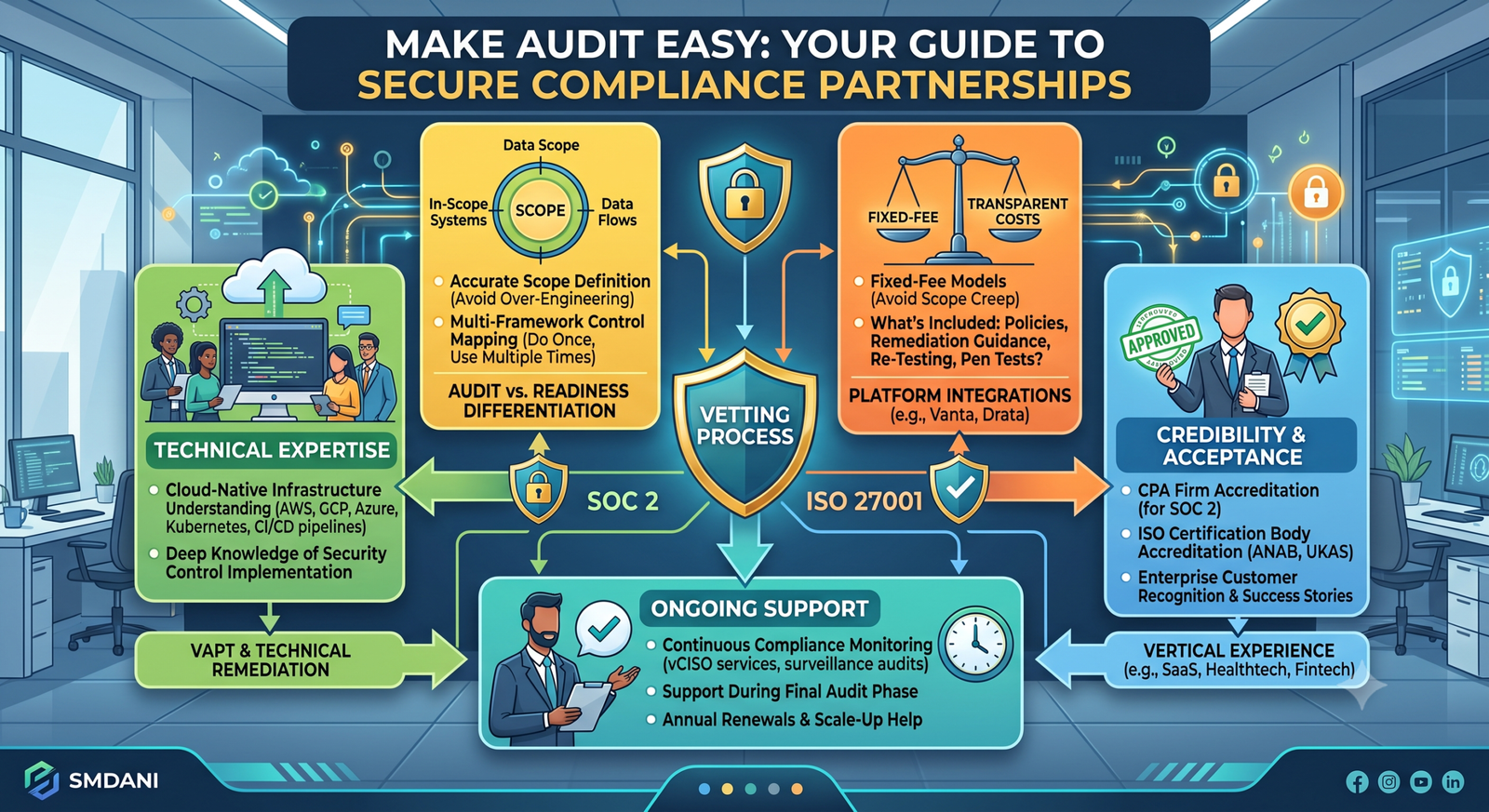
1. Scope & Framework Alignment
- Audit vs. Readiness: Clarify whether the vendor handles readiness consulting (gap analysis, writing policies, implementing controls) or attestation/audit execution (issuing the official SOC 2 report or ISO 27001 certificate).
- Multi-Framework Mapping: If you need both SOC 2 and ISO 27001 (or HIPAA/GDPR down the road), ensure the vendor can map controls once across multiple frameworks to prevent redundant work.
- Scope Definition Guidance: A good vendor helps you define a tight, defendable audit scope so you don’t over-engineer controls or audit systems unnecessarily.
2. Technical & Industry Expertise
- Cloud-Native Understanding: Your vendor must understand modern cloud infrastructure (AWS, GCP, Azure, Docker, Kubernetes, CI/CD pipelines) rather than relying on legacy, on-premise IT checklists.
- Vertical Experience: Ask if they have audited or prepared companies in your specific industry (e.g., B2B SaaS, Healthtech, Fintech).
- VAPT & Remediation Support: Check if they can perform required Vulnerability Assessments & Penetration Testing (VAPT) or provide technical remediation guidance when gaps are found.
3. Pricing Structure & Hidden Costs
- Fixed-Fee vs. Hourly: Look for transparent, fixed-fee pricing to avoid scope creep during the audit.
- Comprehensive Offerings: Clarify what is included:
- Policy templates and drafting support
- Remediation guidance and re-testing
- Auditor coordination/interface
- Penetration testing (if required)
- Platform Integrations: If using automation software (e.g., Vanta, Drata), check if the vendor or auditor works natively with your tool to avoid manual evidence collection fees.
4. Customer Acceptance & Credibility
- CPA Firm Accreditation (for SOC 2): Ensure the final SOC 2 report is issued by an accredited AICPA CPA firm.
- ISO Certification Body (for ISO 27001): Verify the certification body is accredited by a recognized accreditation board (e.g., ANAB, UKAS).
- Enterprise Recognition: Confirm that their audit reports/certifications are well-received by enterprise procurement teams (e.g., Fortune 500 buyers).
5. Post-Audit Support & Continuous Compliance
- vCISO / Ongoing Guidance: Compliance is not a one-time project. Look for partners who offer virtual CISO (vCISO) services or ongoing support for annual surveillance audits and SOC 2 Type 2 monitoring windows.
- Gap Assessment Flexibility: Top vendors often offer free initial gap assessments or discovery calls to evaluate your current posture before committing to a full engagement.
Summary Checklist for Evaluating Vendors:
| Evaluation Factor | What to Ask the Vendor |
| Experience | “How many SaaS / tech startups have you guided through SOC 2 / ISO 27001?” |
| Tool Integration | “Do you integrate with automated compliance tools or open-source setups?” |
| Pricing | “Is this a fixed-fee contract, and does it include remediation re-tests and policy templates?” |
| Deliverables | “Do you provide hands-on policy creation, or just a generic checklist?” |
| Ongoing Support | “What support do you provide during the actual audit phase and for annual renewals?” |